
Hi Friends!
Today let us continue from where we ended last time.
Vajranga fulfilled his promise to his mother, Diti, by defeating Indra. He had also obeyed his father, Sage Kashyapa, by sparing the life of Indra. On the suggestion of his great-grandfather, Lord Brahma, he started an intense penance, while submerged in a huge lake. He meditated upon what is righteous and hence desirable.

In the meanwhile his wife, Varangi, meditated on his well-being while staying on the banks of the same lake. She was under a vow of silence and fasting, as a way to support and parallel Vajranga’s penance.
As expected this intense penance was seen as another threat to his rule over devaloka by Indra, who was already unhappy with the dishonour of defeat he faced by the hand of Vajranga, and the disrespect of sparing his life as a way to further demean him.
Indra decided to partially avenge this disrespect and came over to the lake where Vajranga lay in penance. But the righteous son of Diti was impossible to harm, both based on his strong limbs, as well as the accumulated heat of righteousness due to his tapasya (“penance through heating up of self”).
So Indra resorted to trying to harm the wife of his adversary. This was not the first time he resorted to such tricks. He used his control over the stormy winds by dragging her here and there. By the strength of her penance, Varangi was unharmed by this. He took the form of a wild goat and tried to cause her pain. She remained unaffected. He took the form of a gigantic snake, and coiled around her feet, but she did not break her vow of silence. Then he took the form of a monkey, or marka, and started harassing her immensely. He tugged at her clothes. He defiled the area around her by urinating and defecating, like a wild animal. And then he shook her cruelly, tugged at her hair, and as per some accounts, pierced her eyes. The Beautiful Limbed One remained unperturbed and intent on her penance, but this pained and angered her.
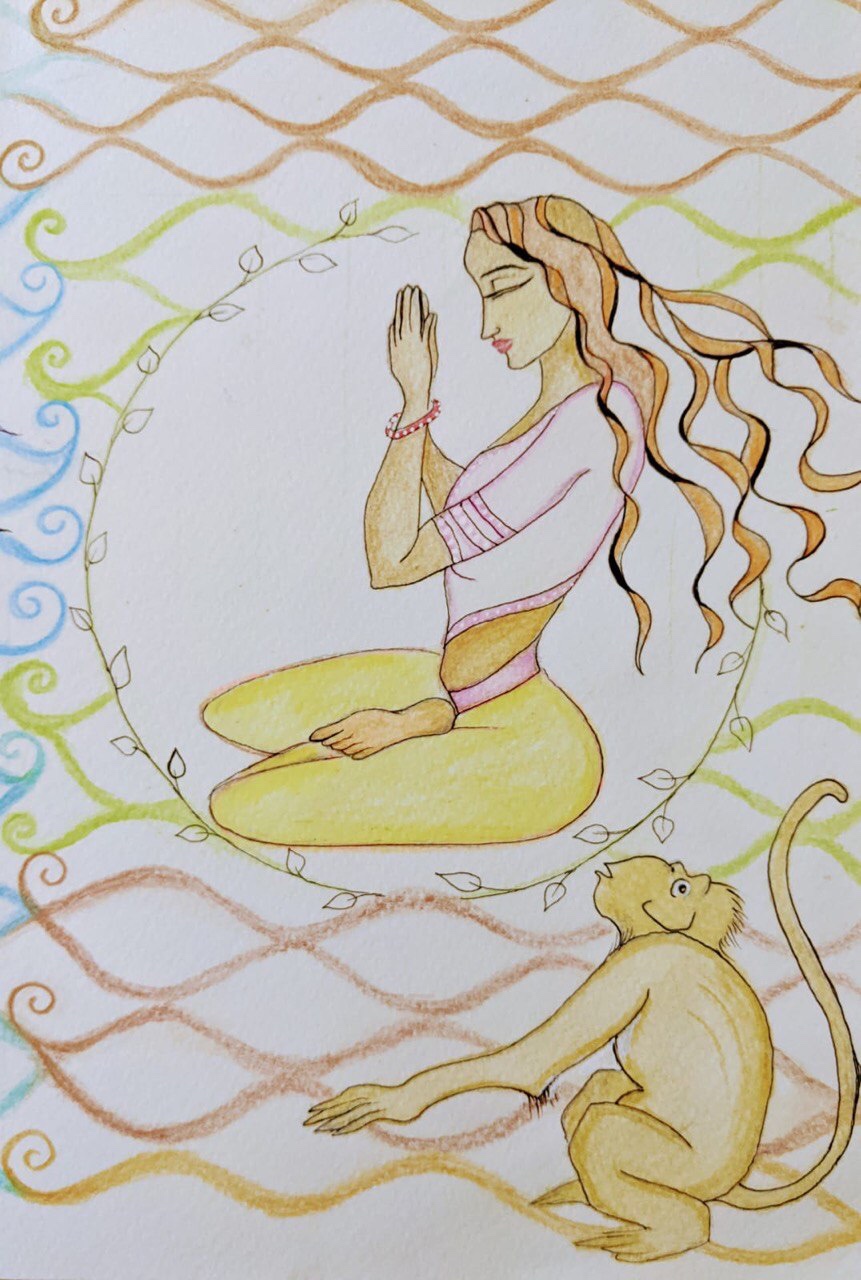
This went on for a thousand years, while Vajranga meditated under water to search for righteousness even after being victorious, and Indra harassed Varangi in an unrighteous way to avenge his own defeat.
It is interesting to note, that in a few stories it is mentioned that tapasya causes the meditating individual, or tapasvi, attract and create heat and light.
This heat is supposed to make them more and more powerful, and also makes it dangerous for the devas, as their own lustre goes dim compared to the intensity of tapa. Please note that the literal meaning of “deva” is the “bright one”.
So the devas try to find ways to stop any tapasya that goes on for too long. If they are unable to do that then they, and in most cases their great-grandfather Lord Brahma, are forced to come and request the tapasvis to stop the tapasya, and for that they promise to fulfil the tapasvis’ wishes, by granting boons.
At the end of the thousand years of tapasya of highest order, Lord Brahma was very happy with Vajranga, and came to visit him, and ask him to stop the difficult penance. As was his wont, Lord Brahma, promised to grant whatever boon Vajranga wished for, and asked him his desire.
This was the point where Vajranga proved once again that he was truly knowledgeable and righteous. He asked Brahma to grant him that his feelings remain pure and correct, and he be never touched by anger or desire for the kingdom and riches of Indra, or anyone else. He only asked for a desire for correct behaviour and pursuit of virtue.
Lord Brahma was pleasantly surprised, and saddened as well. He knew of the misdeeds of Indra in the meanwhile (and maybe about what future held in store), but he could not refuse the request for such a beautiful boon. He granted Vajranga all he wished for, blessed him lovingly, and went away.
After gaining his heart’s desire, Vajranga emerged from under the lake, and sought his wife. He saw her in a wretched condition, with hair and clothes disheveled and unclean things strewn all around her, while she sat patiently in his wait. He rushed to her and enquired the reason for her plight. At last breaking her vow of silence, Varangi recounted the misdemeanours of Indra, with tears in her eyes.
Though Vajranga was now beyond anger, Varangi had neither sought such a boon, nor received such tranquility. In anger at this disrespectful treatment by the hands of the king of gods, she asked her husband to give her a son who would be her saviour from her misery, and disrespect from Indra.
Then Vajranga, as loving and dutiful husband, started another difficult penance for the sake of his wife’s wishes. Due to his accumulated good deeds, and strength of penance, Brahma had to come hurriedly. Knowing the intent of Vajranga’s tapasya, Lord Brahma said lovingly to him, “O pious descendant of mine, why did you start a penance so soon after the earlier arduous one. You had asked for and received the boon of righteous thought and freedom from anger and covetousness of other’s kingdoms. Then why do you now seek something else? Isn’t that the ultimate form of happiness?”
On hearing this, the gentle Daitya joined his hands in humility and said, “I do not seek anything for myself. I started this penance to redress the woes of my wife. It is said that to not fulfil a heartfelt request of one’s loved one is the way of the unrighteous. So, O divine great-grandfather, please bless my wife and me with a son who would be capable of redressing the cruel humiliation his mother faced by the hands of my half-brother. Let him be unconquerable and strong as his mother desires. And for my sake let him be a good son, an able ruler, a competent leader of his friends and supporters, and most importantly magnanimous even to his enemies.”
Lord Brahma was impressed yet again by the thoughtfulness of his saintly descendant, and happily granted his wishes, and went away after blessing the thoughtful Vajranga, and the revengeful Varangi.
After a long and difficult confinement, Varangi gave birth to a strong son, who became fully grown immediately after his birth. He was stronger than any individual man, daitya, danava, deva or any known type of divine entity.
Varangi was very happy. She had asked for a son who would be strong and act as her saviour from the indignity she had faced. So she named him as Taraka, which literally means “saviour”.
Vajranga was also happy. He had asked for a wise son who would be a good leader of his people. Taraka became learned in all types of knowledge from the Vedas soon after his birth.
He was crowned by all the sons of Diti (the “Daityas”), and the sons of Danu (the “Danavas”), as their king. They together were referred to as the one’s possessed of breath/spirit (denoting strength and stamina) and water (denoting possessions and wealth), or in other words, Asuras. He was the undisputed king of the Asuras, and came to be addressed as Tarakasura.
Tarakasura addressed his friends and followers thus, “O rich Asuras, the strong sons of Diti and Danu! Our enmity with the Devas and Indra has been seeded from our very birth, through the wishes and due to the undue hardships our mothers had to face. We are strong, and may with effort defeat the Devas. Many of our predecessors and elders have done that already, but they didn’t plan ahead, and hence unable to hold on to that power. For our success to be stable, and not fickle like our elder brothers, and fathers, we need to be more powerful, and as close to unconquerable as possible. For that I, along with my major generals, shall undertake penance to get boons of being undefeatable, or as close as possible.”
This impressed the assembled Asuras, and many of them accompanied Taraka, the saviour, to do penance for getting powerful boons.
After a long and difficult penance Lord Brahma appeared in front of Taraka, and asked him for a boon. Taraka asked for immortality and complete undefeatability. Lord Brahma smiled, and said, “O Learned descendant of Vajranga, do understand that any one who is born has to necessarily meet death, even if it is far in the future or difficult. Only way to remain undefeated is to give up the ambition of victory. But your tapasya has pleased me, so please ask as boon a difficult condition for your defeat, and I shall grant that. For you, and for the memory of your righteous father.”
Tarakasura was not just strong and learned, but he was knowledgeable of the various happenings and situations, in the mortal plane as well as the divine plane. He knew about the unfortunate incident at the yagna of Daksha, and the self-immolation by Sati, the wife of Lord Shiva. He also had been informed by his spies, that the Mahadeva had now decided to remain unmarried, in grief of the sad circumstances of the death of his beloved. He also knew that after the abject defeat of the Devas at the hands of Mahadeva’s forces, led by Veerabhadra and Bhadrakali, the relationship between Shiva’s followers, and the Devas was cordial but strained, especially due to insecure nature of Indra.
He used his considerable intellect, and addressed Lord Brahma thus, “O Lord of all Creation from whom all Suras and Asuras claim descent, let it be that I can only be killed by a boy of seven days, who is the son of the Mahadeva, and who is devasenapati (literally meaning the leader of the army of the devas). O Great-great-grandfather of mine, let me be undefeated and unkillable other than that individual.”
Lord Brahma looked at Tarakasura with various expressions on his four faces. The face looking towards the past was sad. The face looking at the present was surprised and even impressed. The face looking at the near future looked a little afraid. And the face looking towards the distant future was inexplicably happy. He said, “So be it, O intelligent son of Varangi!”
The other generals of Tarakasura also gained various boons to strengthen themselves. We would not name every one of them, but let’s enumerate two whose future stories are interesting. The Asura called Mahisha as well as the Asura brothers named Shumbha and Nishumbha, propitiated Brahma separately, and each got the boon that no sura, asura or maanava could defeat or kill him.
Strengthened by their various boons, and ably led by Tarakasura (the “saviour”), the wealthy and spirited Asuras (literally means that) attacked the forces of the bright Devas (again literally means that). As expected the Devas came prepared to battle against their Daitya and Danava brothers, ably supported by Lord Vishnu, the Preserver, and the saviour of the devas in their many battles with the sons of Diti and Danu.
Some of you may have heard stories of another war, wherein a mortal incarnation of Vishnu fought to avenge the disrespect by a king of rakshashas, of woman who hadn’t harmed that king.
In that (future) war, the saviour was supported by an army of vaanaras (referred to in some stories as an army of “disrespectful” monkeys) and that army had a strong and intelligent champion, sometimes referred to as Bajrang. Interesting parallels!
Let us explore next time who wins in this battle between the two armies, of the Suras and the Asuras. Each army led by or championed by a saviour. One of whom was Tarakasura, the saviour of his mother Varangi’s disrespect, and the strong and intelligent son of his father Vajranga. And the champion of other side was Lord Vishnu himself. All because of Indra, the king of devas, took the form of a monkey and disrespected a woman who hadn’t harmed him.
Any guesses of the outcome?
I am sure most of you have guessed right. So just to keep the curiosity alive I will let slip of a small lesser known detail we shall explore next time.
We will meet the entities called rakshashas first time in the next story. And as usual there is a twist to the tale.
 Tales from Indian Mythology from a Story Keeper
6 thoughts on “20 – The Tale of the Saviour and the Disrespectful Monkey”