
Hi Friends!
Everything has to start somewhere. Day starts with sun-rise. Some songs start with a beautiful melody. Some start with someone mumbling about something he/she feels strongly about.
So, when the tellers and the listeners of stories, gather around a glowing thing (a fire sometimes, sometimes a screen!) this is what needs to be answered first. How did it all start? But before that, by Whom?
Interestingly Indian mythology believes that everything is cyclical. That is, it believes that things keep happening again and again. May be because they noticed the sun rise, then set, and rise again.
But it also believes that every time this happens, slight differences occur. May be because they noticed the monsoons come every year, but start differently, with different levels of rains, and end differently. Sometimes almost same as last time, but sometimes quite different. Some similarity always, but the differences important, as well.
So, the story of how it all started, what is called technically the “creation myth”, is not consistent. Hence it started a certain way one time, or some other way the other time… and it will start again… but some different way.
To lessen the confusion (I am already confused… why should you!), we will discuss in the next post one of the ways things are supposed to happen. May be touch upon a slightly different version. Later on… in some other post, we may touch upon some other fun ways things may have started.
To set the context, I would like to tell you about the Creators here. The Trinity of Indian Mythology (consisting of four divinities, at least).
First named (but reducing in importance as stories proceed) is Brahma. He is the Creator. Earlier stories made him the most important. The All Father (like in Western Mythologies) – source/parent/grandparent of all the gods (lowercase “g”), including the King (of gods… we will come to him). He was meant to be the personification of the supreme consciousness, the param brahman. He was denoted to be sitting on a Lotus – which is a thing of complexity arising from the shapeless mud – a metaphor for creation out of chaos. But as stories evolved he became the secondary creator – someone who created what’s within reality – but in the reality created by someone else. Never worshipped alone. Actually never truly worshipped. Only in stories do you hear of people worshipping Brahma, and getting boons. Mostly the villains, though! More of that later.
The second named is Vishnu. He is the Preserver. Earlier stories made him the youngest member of the family of 12 brothers (the eldest was the King… we will surely come to him later), who denote the Sun. The Aditya’s. Each month of the year. A different Sun God. He was meant to be the personification of the sun in its triumphant form, as he stepped across all of known universe in three steps (One “three steps” story will come up later). Morning. Forenoon. Afternoon. But as stories evolved he became the god associated with the rulers (will tell you how!). He is hence considered by a few (quite a few) stories as THE primary creator. Brahma’s primal lotus arose from HIS navel. His belly-button. Interestingly, as you all know, the belly button is where YOU were connected to your parent… and not the other way around. Still… the most structured mythological stories are the one’s told and retold by the followers of Vishnu. Hence quite a few of our stories would be about HIS versions. But please keep in mind, it is just one “truth”. One version of the “story”.
The third named is Shiva. He is the Destroyer. Earlier stories made him the personification of the wind, the hunt, the senses, with eleven forms (five organs of action + five organs of sense + mind, the organ of decision… beautiful right?) or eleven sons or eleven followers. He was strong, but sometimes he, sometimes his sons the Rudras (“the terrible ones”), and sometimes his grandsons the Maruts (“winds”) were helpers and assistants to the King (he keeps cropping up.. we will come to him later). Shiva was worshipped by the other tribes, or was quite similar to their god/gods. So, a few stories of the victory of the other tribes over the tribe that worshipped Brahma, and gods born from him, was later included in the stories of Shiva. We will talk of a story about one such “victory” in detail later.
Before we go to the fourth member of the Trinity (seriously!), I would like to tell you a story of numbers. See we counted 12 Aditya’s, for the 12 months of the year that Sun shines on us. Then we counted the 11 Rudra’s, for the five sense organs + five action organs + one thought organ (“mind” or “soul”). To these are added 8 more gods (lower case “g”). These are the Eight Vasu’s. Literally “occupiers” of the eight elemental or natural phenomenons. Namely fire, earth, wind, space, sun, sky, moons and stars. Strangely the sun comes here as well. As I said, confusing. Add to these two more, the twin-gods of horses, medicine and sciences – the learned things rather than purely nature as the others – called the Ashvin Kumaras. So we have 12+11+8+2 = 33. Interestingly whenever people say Indian mythology has 33 crore gods, they actually mean the 33 gods, from which all other gods somehow derive. We will find interesting stories about the 8 Vasu’s and the 2 Ashvin’s in stories from the longest epic story of Indian Mythology.
Interestingly all 33 gods (lowercase “g”) above (and the three main uppercase “G” Gods of the trinity, who may or may not be part of the 33) are all males. Men. Boys. Or Purusha.
This bring us to the fourth divinity who is part of the Supreme Trinity, though not included openly.
She is the Mother. Not just your mothers, my friends. Though they surely deserve to be part of any list of divine beings. But the All Mother. The one who gives birth to all. Nature, or Prakriti.
She is the Creator, in her form as the Earth, the fertile land, itself. In her form of Saraswati, or Amba.
She is the Preserver, in her form of the crops and trees that give us food, and shelter, and everything else. In her form of Gauri, or Lakshmi.
She is the Destroyer as well, when Nature becomes scary, in her form of floods, storms, droughts, wildfire, and earthquakes. In her form of Durga, or Maha-Kali.
Makes sense right!
In some stories the Mother is from whom all the gods take birth. In some she is wife of some gods. Sometimes she is daughter of some gods. In one she is formed from parts taken from all the gods, all the good parts, making them stronger even than all of them together.
But she loves us and is loved by us. And sometimes she is strict with us and we are afraid of her. That’s true with all mothers.
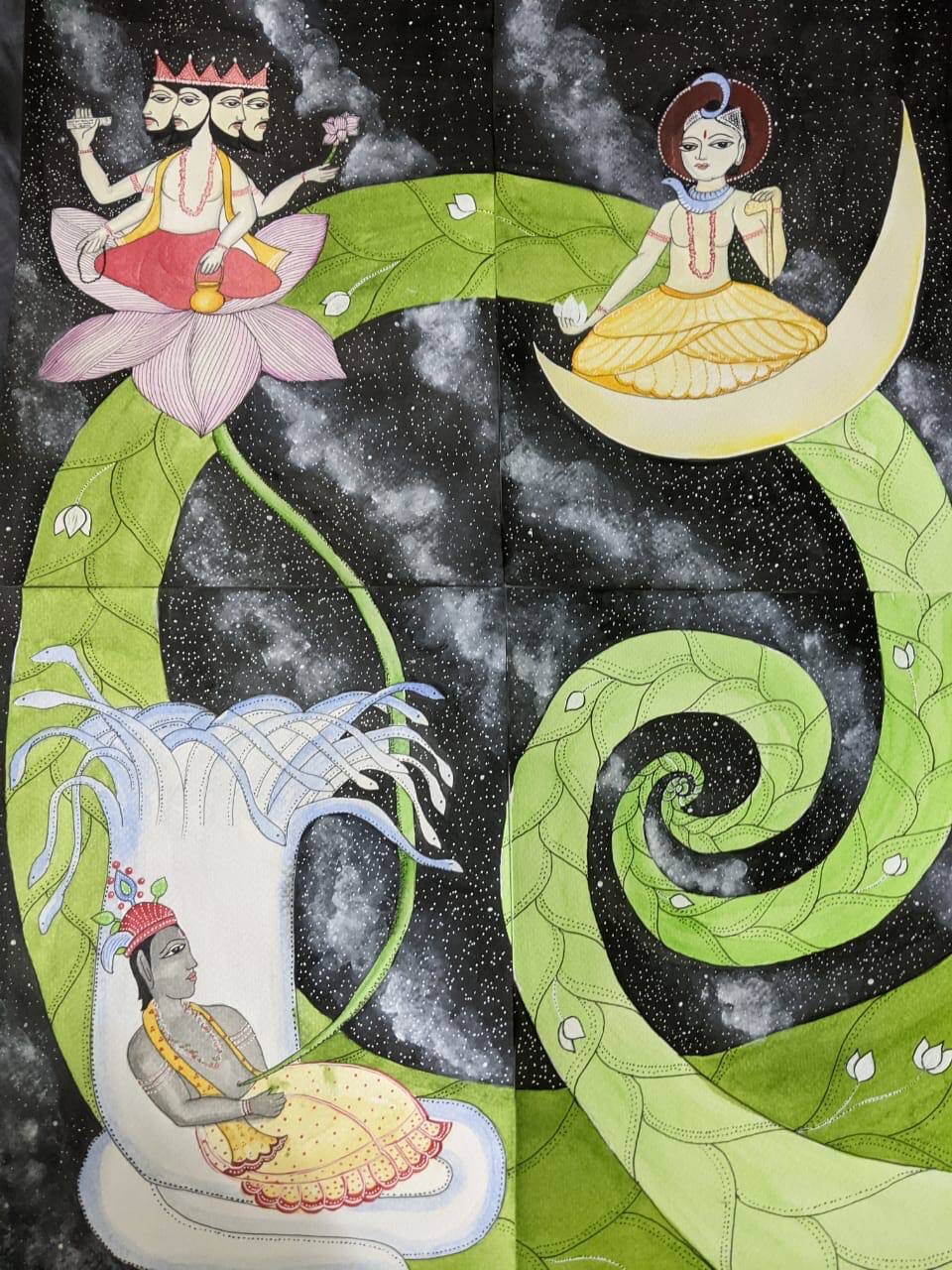
These are the main star cast of our blockbuster stories of mythologies, and they will meet us time and again. In these forms or other. Or in form of incarnations, or avatars. Some of them are even Blue as in that awesome movie! And sometimes their sons (and daughters) would play major roles. Look forward to delve into this treasure-trove with you all.
 Tales from Indian Mythology from a Story Keeper
Great stuff. My daughter loved it.
LikeLike
Thanks for the feedback bro! Will try and post the one on creation this week. Do check back.
LikeLike
This is so beautifully put. I am so glad my son has this version of Indian mythology he can read.
LikeLike
Thanks… I hope Vinu can help with some illustrations… His interpretations of each post/ story … would love to add them in here.
LikeLike
Amazing! And I love the way you presented it.
LikeLike
Thanks Vihaan. Means a lot!
LikeLike
Jabardast !
LikeLiked by 1 person
Thank you rahega!
LikeLike
It was very interesting. I really liked the way you tell the story about the fourth member of trinity. I have a few questions:
1. What is the difference between upper case G gods and lower case g gods?
2. Why is Brahma never worshipped?
LikeLike
Thanks. I always found the absence of Shakti (Devi) from the Trinity (Tridev) quite baffling.
Let me try to answer the questions to the best of my abilities.
1. I use the uppercase Gods and lowercase gods to differentiate between the more powerful, senior, and omnipotent divine beings in mythology, and the less powerful, junior, and sometimes helpless (and helped/saved by the uppercase Gods) divine beings. In fact interestingly in every Manvantara these lowercase gods (along with the Indra, the Saptarishis and Manu) changes. In the next Manvantara, or interval of the next Manu, the King of gods, would be Mahabali, and Ashwathama would be one of the Saptarishis. Please note Mahabali was the one exiled to Paatal by 5th Incarnation of Vishnu, Lord Vamana. And Ashwathama was cursed to an eternity of pain and wandering by the 8th (or maybe 9th) Incarnation of Vishnu, Lord Krishna. Interesting? It is supposed to signify that being a lower case god (or can be called Demi-gods) is more of a position, and is reached and can also be taken away. Remind me someday to tell you about Nahusha.
2. Brahma is not worshipped everywhere. There are still a few temples where he is worshipped. One is well known, the temple at Pushkara. There is an awesome legal case regarding the same (Ask your dad or mom to search and explain to you.) There are a few stories regarding the same. We may cover them in details later. One story is that he lied that he found the top of the beam of light that was Shiva, hence was cursed to be never worshipped, as he saw the need to lie to prove his supremacy. (May be those who want to be worshipped more, are the one’s who least deserve to be worshipped. Right?) Another story is that he was cursed by his wife Saraswati (or Savitri) as he did not wait for her to get ready for conducting a yagna, and made a new goddess, and wife, for the purpose by bathing a mortal woman in the milk of the Divine Cow, Kamadhenu. By the way this is the origin story of the Goddess Gayatri.
LikeLike