
Hi Friends!
Today let’s try to take forward the story we started in the last post. The one where two sisters asked for strong children. One sister got as sons a thousand serpents with divine powers. The second sister lost her first-born (half-born?) to impatience, but was blessed with another. As this story has a lot of twists and turns, this may spill over to another post.
So, as we saw, the second (and last) egg of Vinata hatched after she had suffered through five hundred years of servant-ship of her sister, Kadru, and her serpentine sons. Out of the egg came Garuda. He was a divine being, destined to be stronger that even the King of gods, Indra, as was planned by the Valakhilyas, cousins of his father, Sage Kasyapa. He became fully-grown in an instant after he hatched. He was a powerful individual, sometimes described as an immense eagle, and sometimes as a humanoid, with the head and the wings of an eagle. He could change his size. He could fly higher than anyone else. He could defeat any one, if he wanted to, but was humble with his elders, and devoid of unnecessary greed.
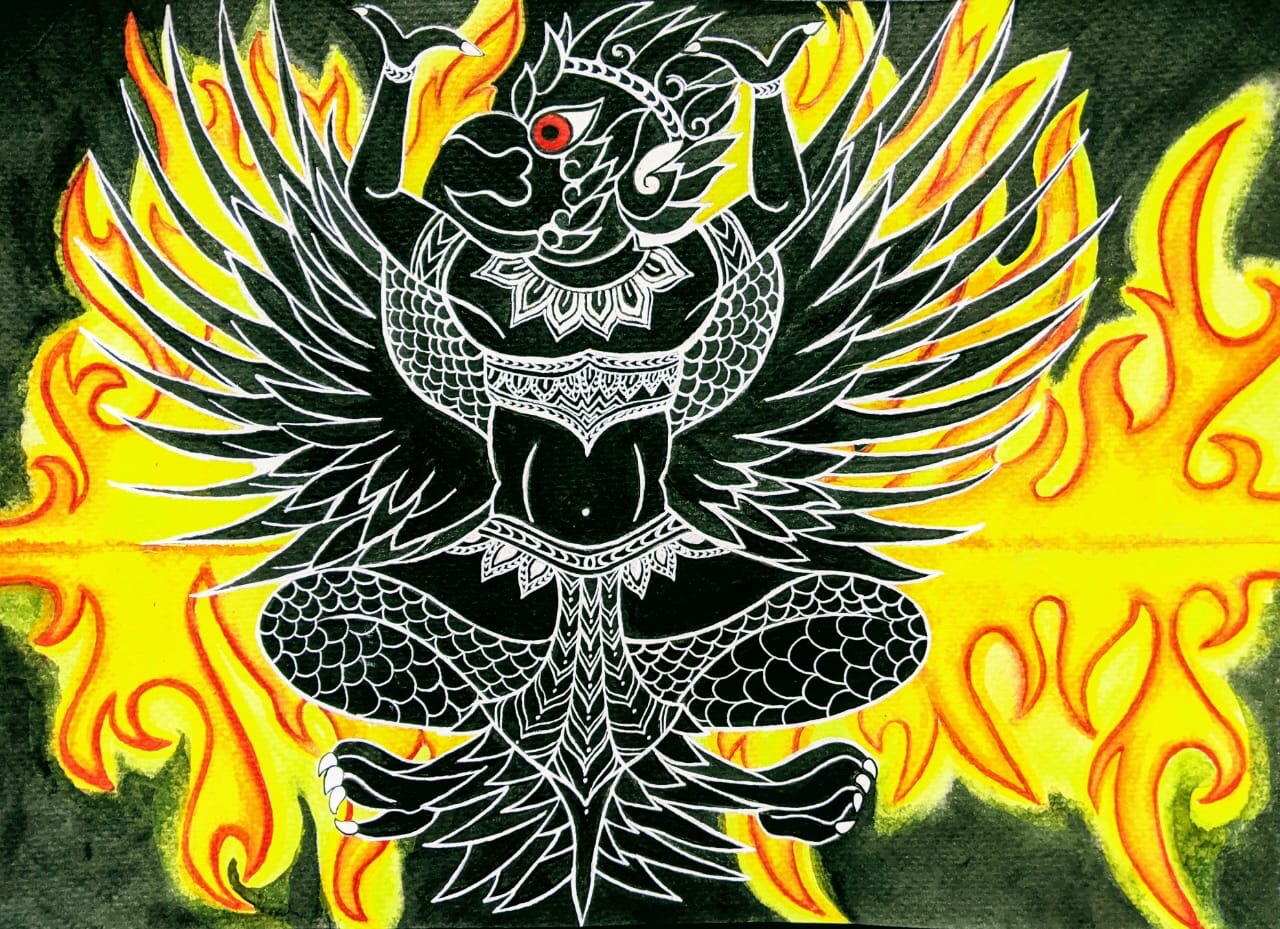
He was born the son of Vinata, and as per the terms of the bet she had lost to her sister, he had to serve his aunt (and step-mother) Kadru and her sons, the powerful serpents, the Nagas. When he asked the reason of their servitude, she told of the trickery. This angered him, but he kept his cool, promising her that he would free them both, with his abilities.
Kadru, and her Naga sons, were afraid of Garuda, and always tried to keep him engaged and subservient to them. One day Kadru decided she wanted to go sight-seeing with her sons. So she told Vinata to carry her on her back, and Garuda to carry her cousin/half-brothers. Garuda in his anger flew so high, that the heat of the sun started to burn the Nagas. Interestingly, this parallel to the story of Icarus, from Greek mythology, is repeated with the sons of Garuda’s brother, which we shall come to in a later post.
In the current story, the Nagas were saved by the resourcefulness of Kadru. She immediately called for Indra’s help, and he brought dark clouds to shield the sun and heavy rains to stop their skin from burning. If you remember Indra had disrespected the Valakhilyas earlier, and they had put in efforts to make Garuda a stronger individual than him. So Indra had an ulterior motive to side with Kadru, and her sons.
Post this “accident”, when the sons of Kadru, were terrifyingly scared and terribly scarred, Garuda went to them and said: “You know that keeping my mother and me as servants is wrong. Hope you would reconsider, unless you want such ‘accidents’ to repeat.”
The Nagas knew that refusing Garuda directly could be dangerous, so they decided to set him a task that was (i) too difficult to compete, (ii) may cause him to get hurt badly, or worse, and (iii) if he succeeded would make them safe from him. So they pompously said: “Even we don’t want such a servant who doesn’t know how to follow orders. We would free you and your mother… If you go fight Indra, and get for us the Nectar of Immortality, amruta.”
You would remember amruta was one of the precious things that came as gifts from the churning of the sea.
Having thus set an almost-impossible condition of his freedom the Nagas felt secure at last. They should not have, as Garuda decided that he would do exactly that. He knew he was strong, but to be doubly sure, he went to his father, Sage Kasyapa, for advice. Sage Kasyapa knew that the behaviour of Kadru, and her Naga sons, had been horrible. So he blessed Garuda, but made him promise to neither disrespect nor unnecessarily hurt the Adityas, the gods who had the amruta with them, as they were also his sons, just like Garuda. He especially told him to keep in the good-books of Lord Vishnu, as he was a benefactor of the Adityas, and had given the amruta to them for safe-keeping.
Realising that for this adventure, his son would need a lot of energy, Sage Kasyapa advised Garuda to eat his fill before starting. In fact he pointed out two large beasts, a turtle and an elephant who were fighting each other, and would not be able to save themselves from him. We will someday come back to the story of the fight of the giant turtle and the elephant. But today they play less-important parts in this story. Garuda did exactly as advised by his father, and scooped up the elephant AND the turtle in a single grip. He could become gigantic, if he wanted to, you see.
To finish his meal, he went and tried to sit on a giant branch. But the branch broke due to the combined weight (gigantic Garuda, big elephant and giant turtle). Garuda quickly flew away, but he realised that below this branch hung the Valakhilyas, sleeping upside down. The same who had helped in the yagna for his birth. Being someone who always repaid good deeds, he picked up the huge branch in his other arm and flew around looking for a way to put down the Valakhilyas safely. The miniature sages woke up and saw how Garuda was powerfully, and unselfishly looking after their well-being. They blessed him for his upcoming adventure, and asked him to put the branch into the sea.
Interestingly the place Garuda put the branch down, the sea-bed rose up from under the sea, and a new island was created. This island came to be known as Lanka. This is an important place, and we will come back to it, when we come to the story of the Seventh Incarnation of Lord Vishnu, the King Rama.
After finishing his meal Garuda flew to the Heavens where the Adityas waited for him.
The gods fought well. The gods fought hard. The gods used all their divine weapons. The gods lost.
This was a battle fought hard and long, so I am not going to try and describe it. Other than that Indra used his strongest weapon, the vajra. In a later post we shall discuss how he got it, and why. But this vajra which was feared by all the Daityas and Danavas, could not even scratch Garuda, and just one feather of his got dislodged. Even then Garuda respectfully admired the strength of his elder cousin (as dislodging one of his feathers was like moving a thousand earths) and flew away with the amruta kalasha, the pitcher containing the nectar of Immortality.
Indra requested for the help of Lord Vishnu, and the Lord of Preservation, flew and intercepted Garuda. Garuda, always respectful, stopped and paid his respects to Vishnu. This humility of his was appreciated by Vishnu. So, he asked Garuda to take a sip of the amruta if he craved immortality, as he deserved it, but return it to the Adityas, its rightful owners.
Garuda politely refused saying: “I am not a mere thief that I would steal immortality, O Lord. I have not, and will not, take a single sip of something snatched by force from its rightful owners. I take this nectar only to free my mother and myself from a slavery borne out of trickery.” He then explained the story till now.
Vishnu was impressed by his honesty, and decided then and there, that he wanted Garuda to be one of his trusted companions. So he asked Garuda to ask for a boon. The Feathered Hero, respectful but with immense self-respect said: “O Lord, your blessing is boon enough, but if you must grant me a boon, please make it so that I am always above you.”
Vishnu found this mix of submissiveness and self-pride endearing. So he took an image of Garuda, and put it in the flag that he carried into any battle. So one of the names of Vishnu (there are many) is Garuda-Dhwaja, or the One with Flag of Garuda. In addition, he granted immortality and more divine power to Garuda, making him the King of Birds. He also decided to make Garuda his mount, or vaahana, which Garuda respectfully agreed to.
In the next post, let us see if the trickery of the Nagas succeeds in making them immortal, in return for the well-deserved freedom of Vinata, and her mighty son, Garuda.
 Tales from Indian Mythology from a Story Keeper
Yes, the story is related to Icarus and Daedalus. They were held hostage by King Minos, who was the father of the monster The Minotaur. Daedalus made wings with wax and feathers and he and Icarus flew away with the help of the wings. But Icarus flew too close to the Sun, and the wax melted and Icarus fell and died.
LikeLike
Yes. This type of a mythological story is supposed to be an allegory to too much ambition making people careless, and hence causing harm to themselves. There is another story which follows the Flight of Icarus more closely. Will try and cover in the next post, as it is the tale of two of the four sons of the brother/sister of Garuda.
And awesome that you are finding the connect. Daedalus was the original “mad scientist” of Greek mythology.
He should be the patron saint of mazes, and puzzles. And of “crypto”. Check out the term “Daedalus wallet”.
LikeLike