
Hi Friends!
Today let us look at the Third Incarnation of Vishnu, which is another of the Genesis Myths, and amalgamation of another mythology. Like the Story of the Saviour Fish and the Story of the World-Fathering Turtle we discussed earlier. Interestingly the villain of this story is one of the cursed gatekeepers, who loved Vishnu so much that they opted to be his staunchest opponents. We will cover one version of the story first, and then try and delve into what we can learn from it, using different versions of the story for that.
Sage Kasyapa and his wife Diti, one of the daughters of Daksha Prajapati, were parents to the Daityas (literally meaning “of Diti”). One of them was called Hiranyaksha. His name can mean two things. It consists of two words. (i) “hiranya” which means “golden”, and (ii) “aksha” which means “eye”. So his name can mean the One with Golden Eye (i.e. yellow eyed, we will come to this), but it can also mean the One who has eyes always on gold (i.e. who is envious of and tries to capture others’ gold and other property). Incidentally this was the first incarnation of Jaya, the Gatekeeper friend of Vishnu, cursed to live three lifes, as one of the foremost enemy of Vishnu. This was the Kreta Yuga birth, with his colleague/brother Vijaya having taken birth as the brother of Hiranyaksha, called Hiranyakashipu (we will meet him later).
True to his name (second meaning), Hiranyaksha was envious of his cousins/half-brothers the Adityas, and kept attacking them from his world (Rasatala) to take away their dominion of their world (Devaloka), as well as their position of power in the mortal world (Dharaatala).
In fact he was such a hoarder that at the start of this particular day in the life of Brahma (we covered this measure of time in an earlier post), he hid the Earth, along with her personification as the Earth Mother, or BhooDevi, in the bottom of his dominion, one of the underworlds called the Rasatala, under the ocean. This was putting the work of creation on hold, as the first Manu, Swayambhu Manu, could not access the Earth and help populate it with his descendants, the Manu-shyas, or humans.
The required task of saving BhooDevi, helping the Manu to reach and populate the Earth, reinstating the Adityas’ rule over the heavens, and to end the first cursed life of Jaya, seemed close to impossible. As before starting on this adventure of world domination, Hiranyaksha, may (or may not) have taken the boon from Lord Brahma, that no god, or demigod, could kill him. In fact he may (or may not) have laboriously listed all the animals and birds he wanted protection from.
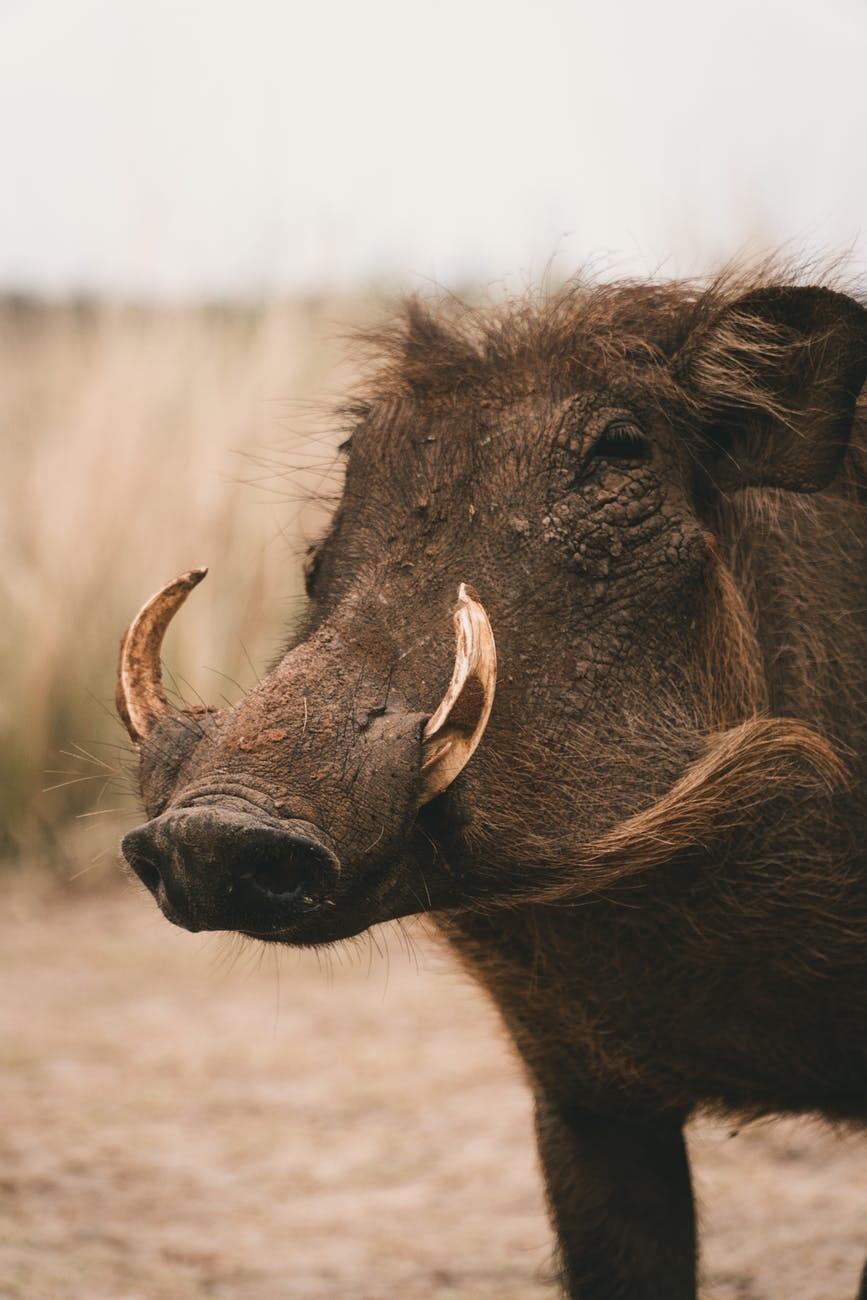
It seems the name of varaha (or shookara), i.e. the wild boar, was missed, knowingly or unknowingly. So out of one of the nostrils of the nose on one of the heads (out of the possible four, or five) of Lord Brahma, a small boar emerged. Being an incarnation of Lord Vishnu this boar grew fast (just like his Matsya incarnation), and was soon big enough to be able to pick up, and expectedly save, the whole Earth.
So Lord Varaha went diving into the ocean, and soon reached Rasatala, where BhooDevi was held captive by Hiranyaksha. He picked up the Earth and started upwards to put it in its rightful place, the level of Earth, literally Dharaa-tala. The kidnapper of BhooDevi, Daitya Hiranyaksha, challenged the would-be saviour, Varaha, to a fight, may be calling him disrespectful names such as “lowly creature”, “cowardly”, and “thief”. And there was a fearsome fight which went on for long time, at the end of which Hiranyaksha was killed by the one creature he had least expected, or feared. The weapon used, to deal the final blow, by Lord Varaha was either his own tusks (or single tusk, as Varaha is also called the One-Tusked One, or EkaShringi), or by his discus – the Sudarshana Chakra, or by his divine mace – the Kaumodaki Gada (we mentioned the various meanings of the two weapons in an earlier post).
Post this Lord Varaha picked up BhooDevi on his tusks, and placed her back in her rightful place. The image of Varaha holding BhooDevi in his tusks, or arms, and she looking happy, as well as shy, is found in many sculptures, temple wall carvings, and pictures.
There is an epilogue of sorts connected to this image. The story continues that BhooDevi asks for a son from Lord Varaha. This son was called Naraka. Later this son of a mighty incarnation of Vishnu, happened to be with bad company (incidentally of a descendant of Hiranyaksha’s brother) and turned to evil ways, and was called Naraka-Asura. His end came in the hands of the eighth (or may be the ninth) incarnation of Vishnu, Lord Krishna, supported by Queen Satyabhama, the incarnation of BhooDevi in the Dwaapar Yuga.
Someday let us discuss the repeated occurrence in many mythologies of the sons of the Mother Earth turning evil, and needing to be defeated (and or killed) by divine heroes or gods. May be this, along with the Daityas being personification of powers (and riches) coming from underground, is an allegory of the reaping (equated to killing or defeat) of crops coming from the ground, needed for the upkeep of a civilised society.
There is another story of Vishnu taking the form of Varaha. I had covered that in an answer to a query from an intelligent reader, as one story to support why Brahma is not worshipped though part of the Trinity.
So let us take this opportunity to cover it in some detail here.
One day Lord Brahma and Lord Vishnu were discussing, in fact arguing, who amongst them was greater. Brahma said that as he caused all creation to form, and gives all the major boons, he was greater. Vishnu said as he preserves the creation, and every once in a while punishes the receivers of Brahma’s boons when they misused their power, he was greater.
At that very moment an immense, seemingly endless, beam of fire and light materialised. This was a curious occurrence and should have made them stop the argument.
But you may have noticed, when an argument is in progress, everything becomes part of the game of one-upmanship. By the way that’s why it is better to “discuss” as then no one needs to be “wrong”. As in an “argument” for you to be “right”, someone else has to be “left” out.
So, the two Lords of the Trinity decided then and there, that whoever finds the end of this Beam of Light and Fire (“agni stambha”) would be proven to be greater. So Brahma took the form of a white swan (“svet hamsa”) and flew up; and Vishnu took the form of a white boar (“sveta varaha”) and dug down. Both went going fast and far, but could not find the end. While flying up the hamsa of Brahma found a flower, Kemukha or Ketaki. He asked the flower if it had seen the end of the beam. The flower said it had not. Now Brahma wanted very badly to win. So he hatched a plan. He made a deal with Ketaki flower that she should tell that she was at the top of the beam, and he (Brahma) brought her from there.
So Brahma called out to Vishnu that he had found the end, and flew back down. There the Varaha (Vishnu) of Strength and Hamsa (Brahma) of Intellect met, and Brahma told the lie he had planned, and Ketaki bore false witness.

At that moment, before Vishnu could accept the supremacy (and worship-worthiness) of Brahma, Lord Shiva came out from the agni-stambha. He was angry with the treachery of Brahma, and said, “O Brahma, who used treachery to steal the right to be worshipped, let it be so that you are never worshipped.” Then he turned to the Ketaki flower, “O Ketaki, who lied that you lay on the top of this representation of infinity, let it be so that you are never used in any worship, and hence never get a chance to be placed on the head of gods.”
And it is also mentioned that he removed one of the heads of the then five-headed Brahma. From then on Lord Brahma is represented with “just” four heads, one looking towards each cardinal direction, as he lost the one which looked up. The story for the reason of Brahma having so many heads to begin with is kind-of interesting, and if someone asks, will tell in the comments.
After Brahma and Ketaki apologised, Lord Shiva reduced the curses. Brahma could be worshipped in conjunction with other gods, but never alone, save for one temple in Pushkara. Ketaki could be used for worship only on the auspicious day of Maha Shivaratri, in the worship of Lord Shiva.
These stories of the Lord of Preservation of Life being denoted as a wild boar has another connotation. The Varaha is also a representation of yagna, or sacrifice. May be when the hunters found a wild boar and were successful in trapping it, they used this occasion of plenty (big animal, lot to eat) to sacrifice to the gods, and pray for more such occasions of plenty. Also, as mentioned in an earlier post, yagna can be seen as any long and difficult process to get some desired results. So these stories of a varaha digging deep into earth and oceans, for the betterment of all, is a representation of the need of undertaking difficult tasks to achieve greatness, and even preservation of the achieved civilisation.
Interestingly, when in the Mahabharata, learned sages enumerate the many Manvantara and the Indra’s and Vishnu Incarnations in each, the first Indra, who also was an Incarnation of Vishnu, is called Yagna. This was in the Manvantara of Swayambhu Manu. This yagna (may or may not be the same yagna as Yagna Varaha of this tale) was not only the first king of gods, but also the father of the first set of gods. So these stories of Varaha, as the Uber-masculine Primal God, and the Father of the son of Earth, and also being the king and father of gods, may be remnant of another religion amalgamated in the story system of Indian mythology.
Like Matsya and Kurma avatars may be remnant of the amalgamated stories of a sea-faring people, for whom water was the source of all riches, and troubles, maybe the Varaha avatar is the remnant of people who saw the hunt-of-the-forest in addition to the catch-of-the-waters as the measure of prosperity.
Later we had the primacy of Indra (“vedic hymns”) when following the vagaries of monsoon became the source of the strongest joys and sorrows. The movement of the Indian belief system post that is a lot more diverse, and interesting. Let us together explore some other aspects of these intertwined stories in the posts to come.
 Tales from Indian Mythology from a Story Keeper
4 thoughts on “12 – The Interesting Story of an Immense Boar”